Reframing the Narrative: AJwD and GSAI Champion Inclusive Storytelling Across Africa
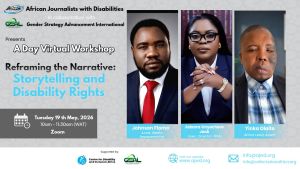
The African Journalists with Disabilities Network (AJwD), in partnership with Gender Strategy Advancement International (GSAI), has renewed calls for a transformation in how disability issues are reported and represented across Africa following a high-level continental webinar on “Reframing the Narrative: Storytelling and Disability Rights.”
Held virtually on May 19, 2026, the webinar convened journalists, disability rights advocates, civil society leaders, development practitioners, policymakers, and media stakeholders from across the continent to examine the urgent need for inclusive, ethical, and rights-based storytelling on disability.
The event featured keynote contributions from Yinka Olaito and Johnson Flomo of African Journalists with Disabilities while discussions were moderated by Dr. Adaora Onyechere Sydney-Jack of GSAI.
Throughout the session, speakers emphasized that disability narratives across Africa continue to be dominated by stereotypes, pity-driven storytelling, medicalized framing, and exclusionary language that diminish the dignity and lived realities of persons with disabilities.
Participants noted that the media remains one of the most powerful institutions shaping public perception and societal attitudes. However, many disability experiences particularly psychosocial, intellectual, neurodevelopmental, and neurodivergent disabilities are still poorly understood and frequently misrepresented in mainstream reporting.
The webinar challenged journalists and storytellers to move beyond narratives centered on dependency, tragedy, or charity, and instead embrace storytelling that reflects resilience, innovation, leadership, contribution, and human rights.
Speaking during the session, panelists stressed that persons with disabilities must not merely be subjects of stories but active owners and narrators of their lived experiences. They also called on journalists to deepen investigative reporting around policy implementation gaps, accessibility barriers, discrimination, and systemic exclusion affecting persons with disabilities across Africa.
The conversation further explored how harmful language and ableist portrayals continue to influence newsrooms, digital media platforms, film industries, and public discourse. Participants agreed that transforming disability narratives requires intentional newsroom reforms, stronger ethical standards, and sustained collaboration with organizations of persons with disabilities.
At the conclusion of the webinar, participants adopted several key recommendations aimed at advancing inclusive storytelling practices across the continent. These included increased disability-inclusive media training and newsroom sensitization, stronger collaboration between media organizations and disability rights groups, and the development of ethical disability reporting guidelines and inclusive language frameworks.
The forum also called for greater investment in storytelling that promotes dignity, accessibility, inclusion, leadership, and representation. Participants urged governments, development partners, and media institutions to strengthen accountability mechanisms that monitor implementation of disability rights protections and frameworks.
Importantly, stakeholders emphasized the need to expand the participation of persons with disabilities within journalism, film, communication, and policy spaces, ensuring that media conversations are shaped by those with lived experience.
In her closing remarks, Dr. Adaora Onyechere Sydney-Jack reaffirmed GSAI’s commitment to promoting equitable and inclusive narratives that uphold the rights and voices of marginalized communities across Africa.
Similarly, African Journalists with Disabilities lead, Yinka Olaito reiterated its dedication to strengthening disability-inclusive journalism and reshaping public conversations around disability through ethical storytelling and advocacy.
Both organizations described the webinar as the beginning of broader continental engagements designed to challenge stereotypes, deepen inclusive reporting practices, and build a media ecosystem where persons with disabilities are represented with dignity, accuracy, and respect.