Invisible Disabilities in Africa: Breaking the Silence in the Media and Society
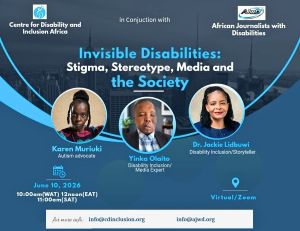
The recent webinar titled “Invisible Disabilities, Stigma, Stereotypes, Media, and Society” brought together thought leaders, journalists, and disability advocates under the joint organization of Centre for Disability and Inclusion Africa and African Journalists with Disabilities as part of their ongoing Disability Rights Monthly Series.
The June 2026 special edition, aligned with global conversations on autism awareness, created a timely platform to deepen understanding of invisible disabilities and the critical role of media in shaping perception, policy, and inclusion.
Opening Reflections: Reframing Invisible Disabilities
The session was opened by Yinka Olaito, who emphasized that many invisible disabilities are often misclassified under broader intellectual disability categories. He called for stronger editorial understanding and more precise reporting on conditions that are not immediately visible.
He highlighted key data showing that a significant proportion of people living with chronic conditions experience invisible illnesses, including neurodivergence, autoimmune diseases, chronic pain disorders, and mental health conditions. His presentation underscored a central message: not all disabilities are visible, yet all are valid.
Lived Experience and Disability Etiquette in Media
Speaking from lived experience, Karen Muriuki stressed the urgent need for mandatory disability awareness and etiquette training within media institutions. She noted that autism and other neurodivergent conditions are often misrepresented, reinforcing stigma and exclusion.
She advocated for journalists to adopt respectful language and ethical reporting practices, particularly when covering hidden disabilities, arguing that media training is essential to eliminate harmful stereotypes and misrepresentation.
Human-Centered Journalism and Structural Change
Disability media expert Dr. Jackie Lidubwi highlighted the transformative power of storytelling in shaping societal attitudes. She emphasized that media must move beyond tokenistic coverage and pity narratives toward authentic, human-centered reporting.
She further noted that journalists and editors “hold the pen that shapes societal reality,” stressing that stereotypes in reporting contribute to systemic barriers faced by persons with disabilities. Dr. Lidubwi also called for the development of inclusive newsroom frameworks and stronger policy ecosystems that embed empathy and accessibility into media structures.
Key Insights from the Webinar
Participants collectively reinforced several critical themes:
- Invisible disabilities include conditions such as fibromyalgia, autism, chronic pain disorders, autoimmune diseases, and mental health conditions.
- A large percentage of individuals live with conditions that are not visibly apparent but significantly affect daily life and productivity.
- Media plays a central role in shaping public understanding, policy direction, and social attitudes.
- Authentic representation requires inclusion of persons with lived experience in everyday journalism—not only during awareness campaigns.
- Storytelling platforms such as documentaries, podcasts, blogs, and news features can amplify dignity and lived realities.
Call to Action
The webinar concluded with a shared call for urgent action: amplify authentic voices, challenge stereotypes, improve newsroom accessibility, and institutionalize disability inclusion in media practice.
As reinforced throughout the session, inclusive journalism is not optional—it is essential to building equitable societies where all experiences of disability are recognized, respected, and represented with dignity.
Through continued collaboration between Centre for Disability and Inclusion Africa and African Journalists with Disabilities, the movement toward inclusive media in Africa continues to gain momentum, ensuring that invisible disabilities are no longer unseen in public discourse.
If you Missed our June 2026 conversation on Invisible Disabilities, read full report here
https://www.linkedin.com/feed/update/urn:li:ugcPost:7477377388289613824/?actorCompanyId=113087970