
Inclusive Africa Conference: Young Africans with Albinism Demand Inclusion, Not Sympathy
At first glance, Elizabeth Senkoro’s story appears extraordinary. At 27, she works as a n Information Technology Officer at a leading energy company in Tanzania, helping manage systems in a sector traditionally dominated by men and professionals without disabilities.
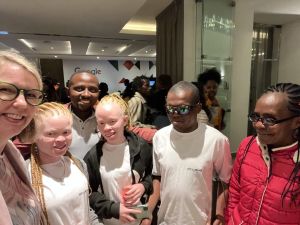
Young People with Albinism(photo Credit: Irene
et for Elizabeth, who was born with albinism, the journey to professional success has been anything but ordinary.
Growing up in Tanzania, she encountered the same stereotypes and misconceptions that continue to affect thousands of people living with albinism across Africa. Society often focused more on her condition than her capabilities.
Today, however, she stands as a powerful testament to what can happen when determination meets opportunity. I caught up with her while she attended the 7th Inclusive Africa Conference, held in Nairobi. The event was themed “Accelerating Digital Accessibility and AI Solutions for Africa’s Future.” Among other issues, the more than 300 delegates in attendance and over 4,000 participants who joined virtually discussed inclusive education, employment, financial services, and assistive technology innovation.
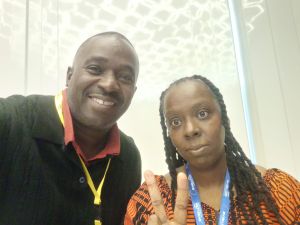
Karen muriuki and tom Mogusu, members of AJwd at the confernce
Elizabeth says that while these subjects are critical, a huge part of the change must begin with individuals accepting themselves.
“You must accept who you are and what you do. That builds confidence and allows you to go the extra mile. It gives you the courage to knock on doors.”
Elizabeth’s story mirrors the experiences of many persons with disabilities across East Africa who continue to battle exclusion, stigma, and limited access to education and employment despite growing legal protections.
Breaking Barriers Through Education
For Elizabeth, education became the bridge between exclusion and empowerment.
She attended Mazinde Juu Secondary School in Tanga, Tanzania, inspired by her older sister, who had excelled academically and later qualified to study law at the University of Dar es Salaam.
Ms Elizabeth Senkoro (above left) with the author of this feature. She was among the more than 300 delegates who attended the 7th Inclusive Africa Conference in Nairobi. This year’s theme was “Accelerating Digital Accessibility and AI Solutions for Africa’s Future.”
“I followed her path and worked hard,” she recalls, adding that she too joined the University of Dar es Salaam to pursue a degree in Information Technology.
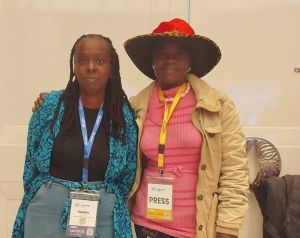
Karen and violet Yimbo- AJwd members attending the conference
Today, Mazinde Juu Secondary School has become known for accommodating and supporting learners with albinism, creating opportunities for more students to pursue their dreams.
But Elizabeth credits much of her success to the support she received at home, where her parents created an environment that encouraged their children to believe in themselves and in the unique talents each of them possessed.
“I thank my parents because they ensured we had the basic needs,” she says.
Beyond academics, she strengthened her credentials through volunteer programmes, including youth initiatives supported by UNICEF and the University of Dar es Salaam. The experience not only sharpened her skills but also enhanced her credibility in a competitive job market.
Her message to employers is straightforward: give persons with disabilities a chance.
“Employers should provide opportunities. Once they do, they will see the potential that exists. Policies should be enforced to ensure people with disabilities are employed.”
From Boardrooms to Communities
Across the border in Kenya, disability rights advocate Goldalyn Kakuya is promoting a similar message.
Known for her advocacy on the rights of persons with albinism, Goldalyn works with young women and girls through initiatives designed to challenge negative perceptions surrounding disability.
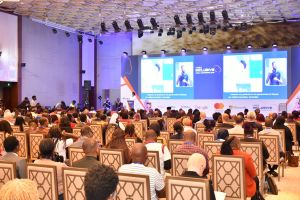
Some participants at 7th Inclusive Africa Conference. This year’s theme was “Accelerati
“What we do is curate activities and initiatives geared towards social change,” she explains. “We want to influence perceptions, attitudes, and general opinions around disability.”
For Goldalyn, disability inclusion must move beyond policy documents and conference rooms.
“It’s about taking the conversation from the boardrooms into the community,” she says.
That mission is particularly significant as Kenya marks International Albinism Awareness Day on June 13. Advocates plan a public awareness walk from Nairobi’s City Square area to Ngong Road, aimed at promoting acceptance and educating the public about albinism.
According to Goldalyn, progress is being made.
“The conversation is shifting from simply doing good things for persons with disabilities to building an inclusive culture. Culture-building takes intention and time, but we’re moving in the right direction.”
She points to recent developments, including the Persons with Disabilities Act and the African Disability Protocol, as important frameworks that can drive change if fully implemented.
“We have the policies. What we need now is implementation and operationalisation.”
The Hidden Barriers
While stories like those of Elizabeth and Goldalyn inspire hope, a newly released report on Africa’s assistive technology landscape paints a sobering picture of the challenges facing persons with disabilities across the continent.
The report, supported by the Mastercard Foundation, reviewed hundreds of studies across all 54 African countries and found that young persons with disabilities remain largely invisible within many support systems.
Access to assistive technology—from visual aids and hearing devices to communication and digital tools—remains limited and uneven.
The report estimates that nearly 200 million Africans require at least one assistive device. Yet in many countries, only between 10 and 25 per cent of those needs are met.
For many young people, access to assistive technology depends not on guaranteed rights but on chance, personal connections, or digital access.
Some of the delegates who attended the 7th Inclusive Africa Conference 2026 in Nairobi.
The challenges are even greater in rural areas, where services are often unavailable.
Researchers found that most assistive technology services are concentrated in urban centres, making them expensive and inaccessible for rural populations. High costs, limited awareness, and social stigma continue to prevent many young people from obtaining the tools they need to participate fully in education, employment, and community life.
The Cost of Exclusion
The consequences extend far beyond individual lives.
The report argues that disability inclusion should not be viewed merely as a social welfare issue but as an economic opportunity.
Young persons with disabilities are already participating in Africa’s assistive technology ecosystem as innovators, entrepreneurs, technicians, and service providers. However, limited financing, weak policy implementation, and inadequate links between training institutions and labour markets continue to restrict their potential.
More than 85 per cent of assistive technology products used in Africa are imported, exposing countries to supply chain disruptions and increasing costs.
Experts believe that investing in local manufacturing, repair services, digital innovation, and disability-inclusive employment programmes could create significant opportunities for youth employment and economic growth.
Changing Attitudes Starts at Home
For both Elizabeth and Goldalyn, however, the most important transformation begins within families and communities.
Elizabeth believes healthcare workers need better training to support children born with albinism and their families.
“Community leaders should normalise conversations about albinism and disability,” she says. “That creates an environment where people are accepted and loved.”
Such acceptance can have life-changing consequences.
When families embrace children with disabilities, they are more likely to attend school, access healthcare, develop confidence, and pursue opportunities that might otherwise seem unattainable.
Goldalyn agrees.
True inclusion, she argues, will not be achieved through legislation alone.
It will come when society stops viewing persons with disabilities through the lens of limitation and starts recognising their talents, ambitions, and contributions.
For Elizabeth, that vision is already becoming a reality.
Despite the challenges she has faced, she refuses to be defined by albinism.
Instead, she chooses to be defined by her abilities.
And in doing so, she is helping illuminate a path for countless others across Africa who continue to fight for the simple right to be seen—not for their disabilities, but for their potential.
#Tom Mogusu, A kanya Journalist and member of African Journalists with Disabilities sent this in from Nairobi’s Inclusive Africa conference 2026 organized by InAble