

Assistive Technology Emergency: Report Reveals Africa Is Failing Persons with Disabilities
A new report launched by the Mastercard Foundation at the Inclusive Africa Conference 2026 has revealed significant gaps in access to assistive technology (AT) across Africa, warning that millions of young persons with disabilities remain excluded from education, employment, entrepreneurship, and digital participation due to inadequate access to essential devices and services.
The “Assistive Technology Landscape in Africa Report”, unveiled on Global Assistive Technology Day in Nairobi, provides what experts describe as the most comprehensive assessment of Africa’s assistive technology ecosystem to date.
Commissioned by the Mastercard Foundation and developed by a consortium led by Stellenbosch University in partnership with Kwame Nkrumah University of Science and Technology, Humanity & Inclusion, and Clinton Health Access Initiative, the study reviewed hundreds of scientific and policy documents covering all 54 African countries.
The report found that approximately 200 million Africans require at least one assistive device, yet access remains critically low, with fulfilled need estimated at between 10 and 25 percent in most countries. Young persons with disabilities are among the most affected, facing barriers such as high costs, limited service availability, long travel distances to providers, and weak support systems.
According to the report, assistive technology systems across Africa remain heavily focused on mobility devices such as wheelchairs, while communication, cognitive, learning, and digital technologies that are critical for education and employment opportunities receive far less attention.
“Access to assistive technology often depends on chance, personal networks, or digital connectivity rather than predictable, rights-based systems,” the report noted.
The study also highlighted significant disparities between policy commitments and implementation. While at least 38 African countries have adopted assistive technology-related strategies since 2016, many lack dedicated financing, monitoring mechanisms, and enforcement frameworks.
Researchers observed that although governments are increasingly prioritising disability inclusion, coordination among sectors such as health, education, labour, youth development, and industry remains weak. Young persons with disabilities are frequently recognised as beneficiaries of policies but are rarely involved in shaping them.
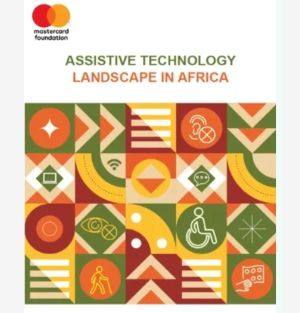
Assitive technology report by MasterCard Foundation
The report further revealed that Africa’s assistive technology market remains heavily dependent on imports, with more than 85 percent of products sourced from outside the continent. This dependence exposes countries to supply-chain disruptions and funding shocks while limiting opportunities for local manufacturing and innovation.
Despite these challenges, the report identified growing innovation across the continent. East Africa was highlighted as having the most dynamic assistive technology production and innovation ecosystem, while other regions are gradually expanding local manufacturing and technical expertise.
Experts involved in the study noted that assistive technology should not be viewed solely as a health intervention but as a key enabler of economic participation, education, independent living, and social inclusion.

Johnson Flomo, Karen , Members of AJwd attending the Conference in Nairobi Kenya
The report also underscored the untapped economic potential of the sector, identifying opportunities for youth employment in product design, software development, repair and maintenance services, manufacturing, logistics, and entrepreneurship.
Speaking on the significance of the report, the Mastercard Foundation said the findings align with its Young Africa Works strategy, which seeks to enable 30 million young Africans to access dignified and fulfilling work by 2030. The Foundation’s Disability Inclusion Strategy, launched in 2023, aims to support 1.5 million young people with disabilities to access education and economic opportunities.
The Foundation said the report would serve as a roadmap for future investments, partnerships, policy engagement, and ecosystem development aimed at strengthening assistive technology access across Africa.
Stakeholders at the conference called for increased investment in local production, digital and decentralised service delivery models, stronger financing systems, and greater involvement of young persons with disabilities in decision-making processes.
They argued that strengthening Africa’s assistive technology ecosystem could become a catalyst for inclusive growth, entrepreneurship, and employment while improving the quality of life of millions of persons with disabilities across the continent.
The report concludes that while policy foundations are increasingly in place, the next phase of progress will depend on implementation, innovation, and sustainable market development to ensure that assistive technology reaches those who need it most.
#Yinka Olaito sent this piece