Africa’s Journalists with Disabilities Launch Landmark Continental Network
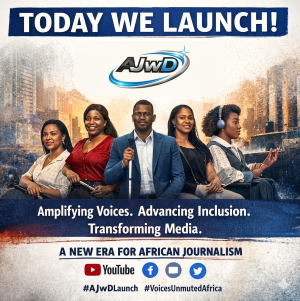
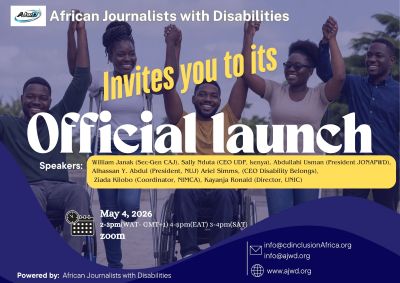
In a moment that blended symbolism with strategy, journalists with disabilities from across Africa and the diaspora convened to launch a new continental platform aimed at reshaping media narratives and newsroom culture. The unveiling of Africa Journalists with Disability (AJWD), timed to coincide with World Press Freedom Day and Africa Month, signals an ambitious push to centre disability inclusion within the continent’s media transformation agenda.
The Compeer for the day was the South African media advocate Rhulani Baloyi, the virtual gathering drew participants from across Africa and the Americas—an indication of both the urgency and global resonance of the initiative. From representatives of the United Nations to regional media regulators and grassroots disability organizations, the message was clear: inclusion in journalism is no longer optional but it is overdue.
At the heart of the event was AJwD’s Africa Lead, Yinka Oletto, who laid out a bold strategic roadmap for the organization’s first five years. The vision is expansive but precise: to build a continental network spanning 25 to 35 African countries, engage between 5,000 and 6,000 journalists with disabilities by 2030, and establish AJWD as the leading voice on disability inclusion in media representation and policy across Africa.
“We are not asking for access—we are building systems that make inclusion inevitable,” Oletto declared, framing the initiative as both a movement and an institutional intervention.
A Structural Gap in African Media
The launch underscored a longstanding gap in African journalism—the systemic underrepresentation of persons with disabilities in newsrooms and editorial leadership. While conversations around diversity have gained traction globally, disability inclusion has often remained at the margins.
Ziada Kilobo, speaking on behalf of the Network of Independent Media Councils of Africa (NIMCA), delivered a pointed assessment: awareness alone is insufficient. “We must move from recognition to institutionalisation,” she said, urging media regulators and organisations to embed inclusive practices into policy frameworks, hiring systems, and newsroom operations.
Her remarks were echoed by Ronald Kayanja, Director of the United Nations Information Centre, who highlighted the transformative potential of journalists with disabilities in shaping narratives and leveraging digital tools to dismantle stereotypes. He reaffirmed the UN’s support, noting that inclusive media ecosystems are critical to democratic development.
Building Capacity, Changing Narratives
Central to AJwD’s strategy is a robust capacity-building agenda. The organisation plans to roll out fellowship and mentoring programmes, alongside specialised training in investigative journalism, solutions reporting, and digital storytelling. These initiatives are designed not only to strengthen professional skills but also to amplify the voices of journalists whose perspectives have historically been excluded.
In addition, AJwD intends to establish a Media Diversity Knowledge Hub to drive research, data collection, and evidence-based advocacy—an area often lacking in disability discourse across African media.
Partnerships will be critical to delivering on these ambitions. Early collaborators include international advocacy group Disability Belongs, which has pledged technical support and knowledge exchange, as well as regional media bodies and academic institutions. Engagements with UNESCO and other global institutions are also underway, aimed at aligning AJwD’s work with broader media development frameworks.
Towards Inclusive Newsrooms
Beyond training and advocacy, AJwD is setting its sights on systemic reform within media institutions. Among its flagship proposals is an “Inclusive Newsroom Initiative,” which will introduce accessibility standards, certification systems for compliant media houses, and practical toolkits to guide implementation.
The organisation also plans to work closely with national unions, the Federation of African Journalists, and policy actors to push for inclusive hiring practices and accessible workplaces. This includes advocating for legislative reforms aligned with African Union frameworks to combat discrimination in media employment.
For many participants, this represents a shift from charity-driven narratives to rights-based advocacy.
Ashley Nyaley DuPont of Disability Belongs described the initiative as “a defining moment for representation,” adding that global best practices must now be localised to reflect African realities.