Africa climate crisis and Disability: Who Gets Left Behind?
Climate change is often reported through statistics, extreme weather events and economic losses. Yet behind these headlines are millions of people whose experiences remain largely invisible. For persons with disabilities across Africa, climate-related emergencies can deepen existing inequalities, creating barriers to mobility, communication, healthcare, livelihoods and safety.
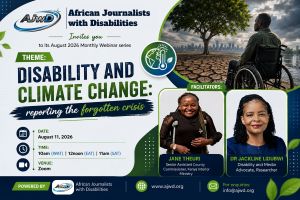
This was the focus of the August 2026 webinar hosted by African Journalists with Disabilities (AJwD), titled “Disability and Climate Change Reporting: The Forgotten Crisis.” The session brought together policy makers, climate experts, students, journalists and disability advocates from across Africa with active contributors from Kenya, Tanzania and Nigeria to examine how climate change disproportionately affects persons with disabilities—and why their stories must become part of mainstream climate reporting.
Opening the session, AJwD Secretariat representative Busola Oladotun welcomed participants and acknowledged the absence of a sign-language interpreter due to a scheduling conflict. She noted that AJwD is working towards greater financial stability to enable the organization to engage professional interpreters when volunteers are unavailable, reinforcing the importance of accessibility in every aspect of public engagement.
The webinar highlighted a critical reality: although Africa contributes relatively little to global climate change, the continent is among the regions most vulnerable to its consequences. Extreme heat, flooding, food insecurity and other climate-related disruptions affect communities broadly, but persons with disabilities often face additional layers of risk.
AJwD Africa Lead Yinka Olaito emphasized the impact of climate change on agriculture, health, education and personal safety. He also challenged journalists with disabilities to use their unique perspectives and lived experiences to bring neglected stories into public discourse and hold governments accountable for inclusive disaster preparedness and response.
Participants shared powerful examples. Faith Munyithya of AJwD Kenya discussed the effects of extreme heat and rising food prices on people with visual impairments. From Nigeria, John Adoyi highlighted additional costs faced by persons with disabilities during crises, including transportation challenges and discrimination experienced when accessing ride-hailing services.
Tuma Dandi Provian, AJwD Tanzania focal person, also shared his lived experience, stressing the urgent need for greater public education about the risks climate change poses to persons with disabilities.
The discussion revealed that climate emergencies are not only about the physical disaster itself. Inaccessible evacuation centres, inadequate transportation, inaccessible early-warning messages and limited access to emergency services can turn a climate event into a crisis of exclusion.
For journalists, this creates both a responsibility and an opportunity. Reporting climate change through an intersectional disability lens can expose gaps in government preparedness, challenge stereotypes and amplify voices that are frequently absent from climate conversations.
The webinar concluded with a call for journalists to continue reporting these realities despite possible resistance or backlash. Participants were encouraged to develop stories based on lived experiences and collaborate on future country-level activities in Kenya, Tanzania and Nigeria, including potential engagement with UN agencies.
The message from the August webinar was clear: climate change is not a disability-neutral crisis. If climate journalism is to accurately reflect Africa’s realities, persons with disabilities must be seen not as passive victims, but as experts, witnesses, storytellers and active participants in building more inclusive and resilient communities.
AJwD therefore calls on journalists, policymakers, development partners and media organisations to make disability inclusion an essential part of climate reporting and climate action.