
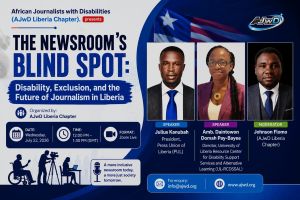
Disability, Exclusion and the Future of Journalism in Liberia
A truly inclusive media landscape does more than report on diversity it reflects it. Yet in Liberia, one of journalism’s greatest blind spots remains the inclusion of persons with disabilities, both in news coverage and within the profession itself.
This was the central focus of the second edition (July 2026) of the AJwD Liberia Webinar Series, which brought together media and disability advocates to examine the current state of disability representation in Liberia’s media ecosystem and identify practical steps toward lasting inclusion.
Speaking during the webinar, Julius Kanubah, President of the Press Union of Liberia (PUL), acknowledged the progress Liberian media has made in amplifying the voices of women and other marginalized communities. However, he noted that meaningful inclusion extends beyond reporting—it requires creating pathways for persons with disabilities to become journalists, editors, producers and media leaders.
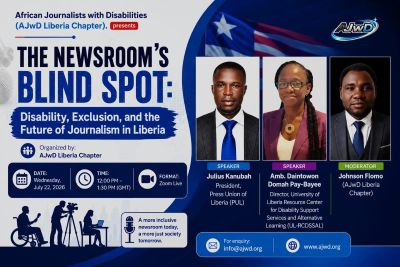
Current estimates suggest that fewer than 15 journalists with disabilities are among the Press Union of Liberia’s 1,527 registered members. While these figures remain unofficial, they point to a significant representation gap that reflects broader structural barriers across the profession.
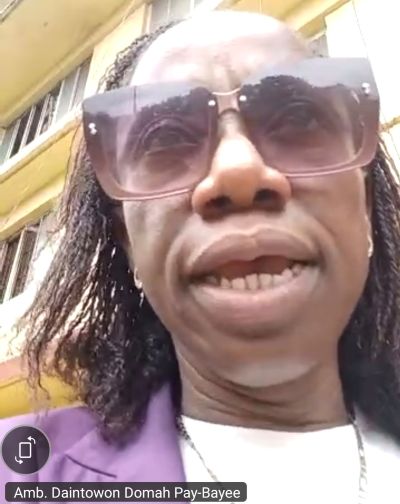
Ambassador DaitowonDuma Pay-Bayee, Director of the University of Liberia’s Resource Center for Disability Support Services, emphasized that disability inclusion must be approached as a human rights issue rather than a charitable initiative. Although the University of Liberia has introduced important accessibility measures—including ramps, sign language interpretation services and improved support for students with disabilities—many media institutions have yet to adopt similar standards.
From inaccessible workplaces and limited assistive technology to the absence of Braille resources, captioning and adaptive computer equipment, these barriers continue to prevent qualified professionals with disabilities from fully participating in journalism. As Ambassador Duma PB observed, hiring persons with disabilities without providing the tools they need to succeed is inclusion in name only.
The discussion also highlighted the role media organizations must play in shaping public attitudes. Inclusive journalism is not simply about covering disability stories; it is about ensuring persons with disabilities are represented across every newsroom and every beat—from politics and governance to sports, business and investigative reporting.
Looking ahead, both panelists outlined concrete actions to advance disability inclusion. The Press Union of Liberia plans to conduct a nationwide survey on journalists’ welfare, including data on journalists with disabilities, while also reviewing its constitution to strengthen disability inclusion within the union. PUL will further pursue partnerships with organizations such as War Hope International to build journalists’ capacity for inclusive reporting.
Meanwhile, the University of Liberia intends to convene a national conference with tertiary institutions to promote disability inclusion across higher education, helping create stronger pathways into professional careers, including journalism.
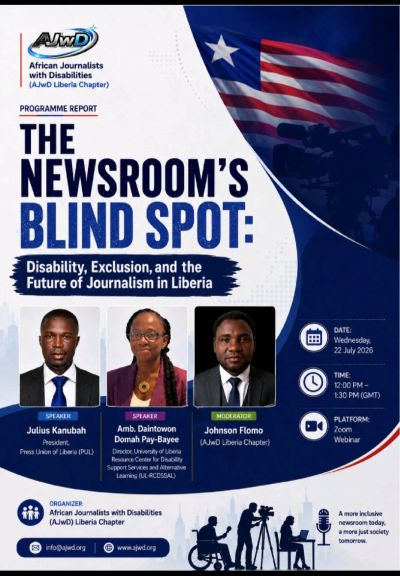
Read full report here or click this link https://www.linkedin.com/feed/update/urn:li:ugcPost:7486042069468332032/?actorCompanyId=113087970
The webinar concluded with a clear message: achieving inclusive journalism requires intentional leadership, institutional reform and sustained collaboration. When persons with disabilities are empowered not only as subjects of news but as storytellers, decision-makers and industry leaders, journalism becomes more representative, more credible and better equipped to serve every Liberian.