
CRPD: Monitoring Rights, Driving Change: Lessons from Australia and New Zealand
The just concluded two days Australia Federation of Disability Organizations 2026 conference with the them ‘Rights.Voices.Actions’ was quite insightful. Yinka Olaito here shared learnings from one of the sessions.
Signing international treaties is easy. Turning those commitments into meaningful change in people’s lives is much harder.
That was the central message from a compelling discussion during the second day of the 2026 Australian Federation of Disability Organisations (AFDO) Conference, where disability rights leaders from Australia and New Zealand explored the importance of independent monitoring in advancing the rights of persons with disabilities.
The session, titled “Establishing an Independent Monitoring Mechanism under the Convention on the Rights of Persons with Disabilities (CRPD),” brought together Rosemary Kayess, Australia’s Disability Discrimination Commissioner, alongside disability researchers Dr Robbie Francis Watene and Umi Asaka from New Zealand’s Donald Beasley Institute.
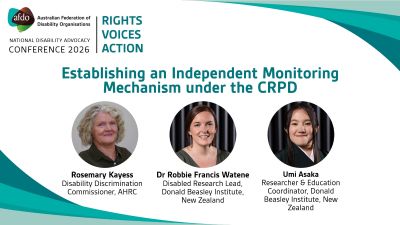
At the heart of the discussion was Article 33 of the CRPD, a provision that requires countries to establish independent systems for monitoring how disability rights are being implemented. More importantly, it insists that persons with disabilities and their representative organisations play a central role in that process.
According to Kayess, Article 33 is rooted in the disability movement’s enduring principle of “Nothing About Us Without Us.” It moves beyond consultation and places persons with disabilities at the centre of monitoring, evaluation and accountability.
She explained that independent monitoring mechanisms are expected to assess the impact of disability-related laws and policies, collect data, develop indicators, and make recommendations that governments can act upon. Such mechanisms must also be independent of government and adequately resourced to perform their functions effectively.
Despite being an early supporter of the CRPD, Australia has yet to formally establish an Independent Monitoring Mechanism. While the Australian Human Rights Commission performs some monitoring functions, Kayess noted that the arrangement lacks dedicated funding and a structured framework that fully aligns with CRPD requirements.
She pointed to concerns previously raised by the United Nations Committee on the Rights of Persons with Disabilities regarding Australia’s monitoring approach and the absence of a formal participatory structure involving organisations of persons with disabilities.
For Kayess, a stronger monitoring framework would improve transparency, provide better access to data and evidence, and create a more robust system for evaluating government performance on disability rights commitments.
New Zealand’s experience offers an alternative model.
Dr Robbie Francis Watene described how Aotearoa New Zealand established its Independent Monitoring Mechanism in 2010, bringing together the Human Rights Commission, the Ombudsman’s Office and the Disabled Persons Organisations Coalition.
The model reflects a commitment to ensuring that disabled people are not merely consulted but actively involved in evaluating whether government actions are improving their lives.
Watene emphasized that while governments can report on policies and programmes, people with lived experience of disability provide insights that cannot be captured through official statistics alone.
That commitment to lived experience is reflected in the work of the Donald Beasley Institute, where disabled researchers lead monitoring activities.
Umi Asaka explained that the Institute uses the Disability Rights Promotion International methodology, which gathers evidence through interviews, focus groups and accessible surveys. The approach is designed to amplify marginalized voices, document barriers and strengthen disability advocacy.
Importantly, the research process itself is led by persons with disabilities. Research teams are intentionally diverse, including Māori, Pacific peoples, people with learning disabilities and members of the Rainbow community.
The session also highlighted the importance of intersectionality in disability rights monitoring. Speakers noted that disability often overlaps with other identities, including ethnicity, gender, sexuality and socioeconomic status. Effective monitoring systems must therefore be designed to capture these varied experiences.
Asaka explained that reaching groups often described as “hard to reach” requires deliberate effort. Accessible information, diverse research teams and strong community networks are essential to ensuring that no voice is excluded from the monitoring process.
Throughout the discussion, one message stood out: monitoring is not simply about compliance. It is about social change.
Independent monitoring mechanisms help identify gaps between policy and practice, provide evidence for advocacy, and hold governments accountable for their commitments. Most importantly, they create opportunities for persons with disabilities to shape decisions that affect their lives.
Nearly two decades after the CRPD was adopted, the conversation at AFDO 2026 served as a reminder that rights are only meaningful when they are implemented, measured and monitored.
For disability advocates across the world, the challenge is no longer whether disability rights should be protected, but how governments can ensure that persons with disabilities are genuine partners in making those rights a reality.
As the conference discussion demonstrated, the answer begins with listening to those whose lives are most affected—and ensuring they have a permanent seat at the monitoring table.